A scene from your world
Last run of the night
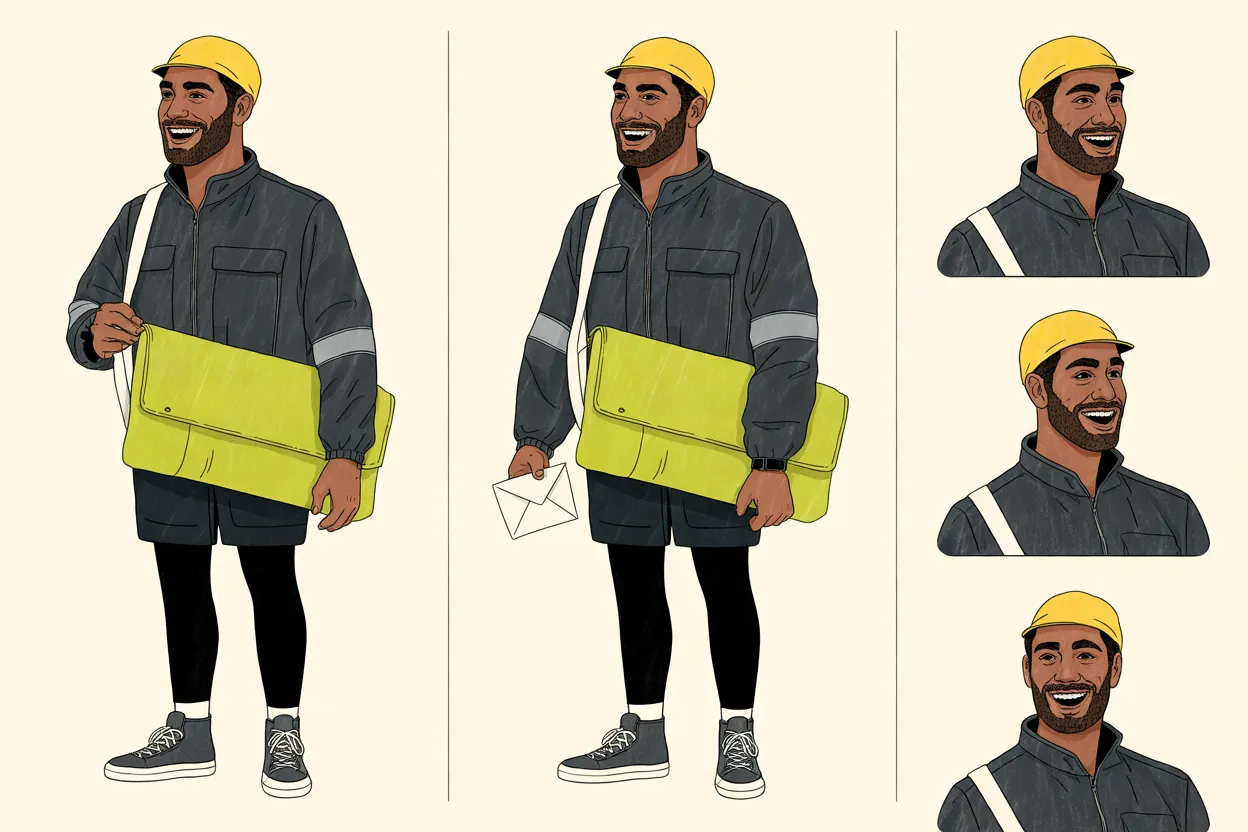
The clock above the subway stairs says 11:52, and the Night Courier takes that personally. He has one envelope left in the bag, sealed, addressed in pencil to a drafting room on the far side of the bridge, and a rule he made up years ago and has never broken: paper gets there before the day does.
“Eleven fifty-two,” he tells the clock, rolling the bike back off the curb. “Call it eleven fifty. You run fast and we both know it.” The clock, as usual, says nothing. The green lamps on the stairs hum. Steam comes up through the grate and goes straight through him, warm for half a second, and then the avenue opens out ahead, long and empty and striped with light.
He rides a steel track bike with one gear and no coasting, which means his legs are always talking. The sour-green bag sits across his chest with the strap doubled over so nothing swings. Tonight it carried eleven envelopes and two blueprint tubes, all of them sealed, all of them signed for by people who looked up from their desks and said some version of “already?” He lives for the “already?”
On the rack behind him the boombox plays the tape it always plays, the one he dubbed himself, A-sides only, no filler, because a run has no room for filler. The dispatcher’s voice crackles over it from the radio clipped to the strap. “Courier. You still out?” “Still out. Last one. Tell them to keep the door open.” “Door’s open.” “Then tell them to keep it open faster.”
He takes the long block at full tilt, drops a shoulder into the turn by the print shop, where the lights are still on and the big machines are still breathing out tomorrow’s drawings, and climbs onto the bridge. The bridge is the only hill in his city and he treats it like a conversation he intends to win. Halfway up, the wind off the river gets into the jacket and the reflective tape on his sleeves throws every headlight back where it came from.
At the top he does the thing he does, which is not stop, exactly, but ease off for the length of one breath to look at it: the whole city laid out under him in hazard yellow and asphalt grey, a million windows, and somewhere in there a drafting room with its door open. He grins. He always grins. Then the far side pulls him down the slope and he lets it.
The envelope is on the desk at 11:58. The architect signs for it without looking up, then looks up. “Already?” “Already,” says the Night Courier, already halfway back to the stairs. There is a clock there that owes him an apology.